
Try it yourself
See what you have only read about
Tonearm resonance, cartridge loading, azimuth: subjects of endless forum threads, settled until now by calculation or by ear. With StylusScope and its Test Record you can see them in your own system, in a few minutes.
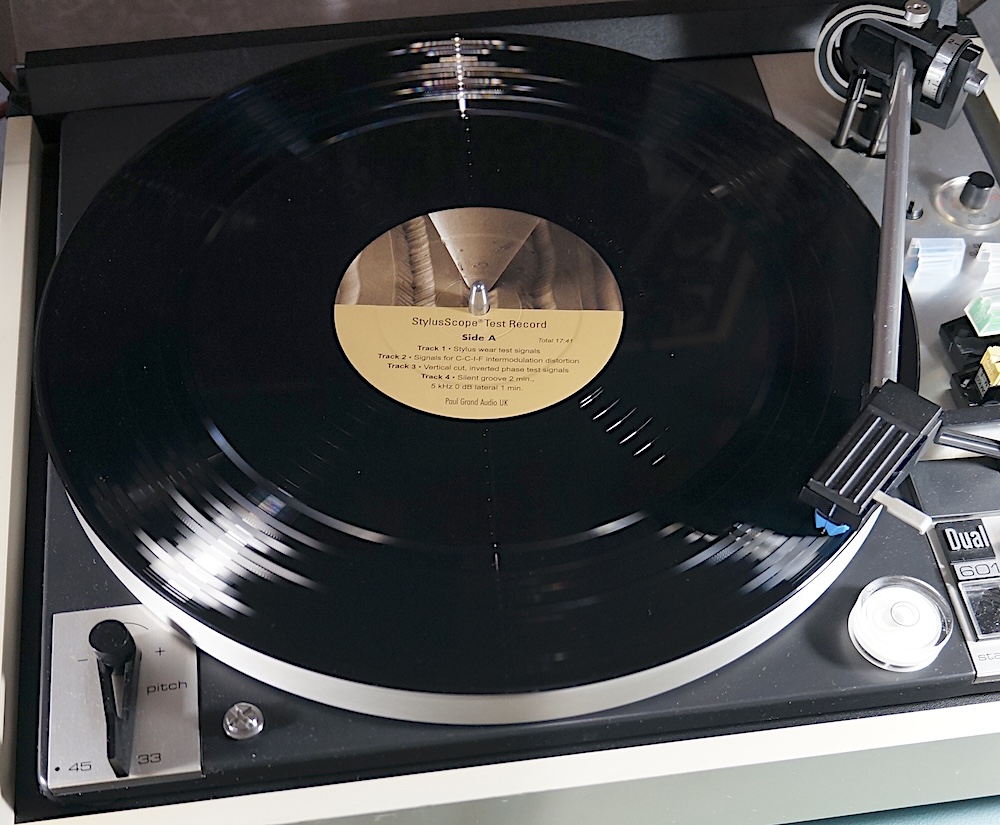
Example 1 · tonearm and cartridge resonance
Your resonance, measured in a minute
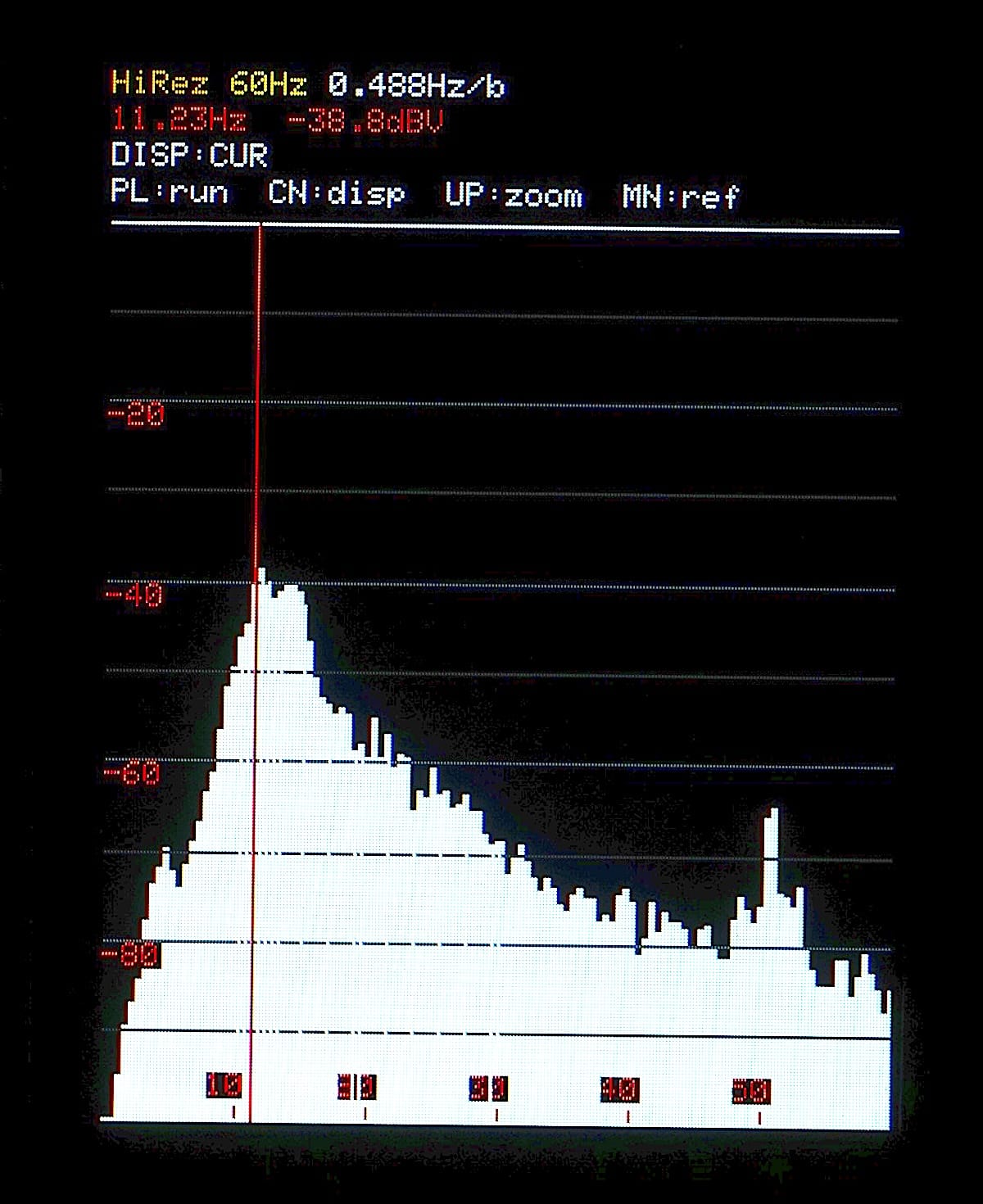
Every tonearm and cartridge pair resonates at a low frequency. The usual recommendation is 8 to 12 Hz: clear of record warps and footfall, below the music. Until now you calculated it from the arm’s effective mass and the cartridge’s compliance, both often guessed. Here the cartridge itself is the sensor.
- In the FFT Analyser settings choose input L-R VERT, Hi-Res 1 kHz, the 100 dB window and 12 averages.
- Play the silent groove at the start of side A, track 4.
- Start an averaged run and keep still.
- Zoom to the 60 Hz window and put the cursor on the peak.
In this example the resonance sits at 11.2 Hz. Outside 8 to 12 Hz? A lighter or heavier headshell, or a cartridge of different compliance, moves it.
Example 2 · cartridge loading
220 picofarads you can see
A moving-magnet cartridge changes its sound with the capacitance it sees: the cable plus the phono stage input. Spec sheets give a figure; your system decides what it does.
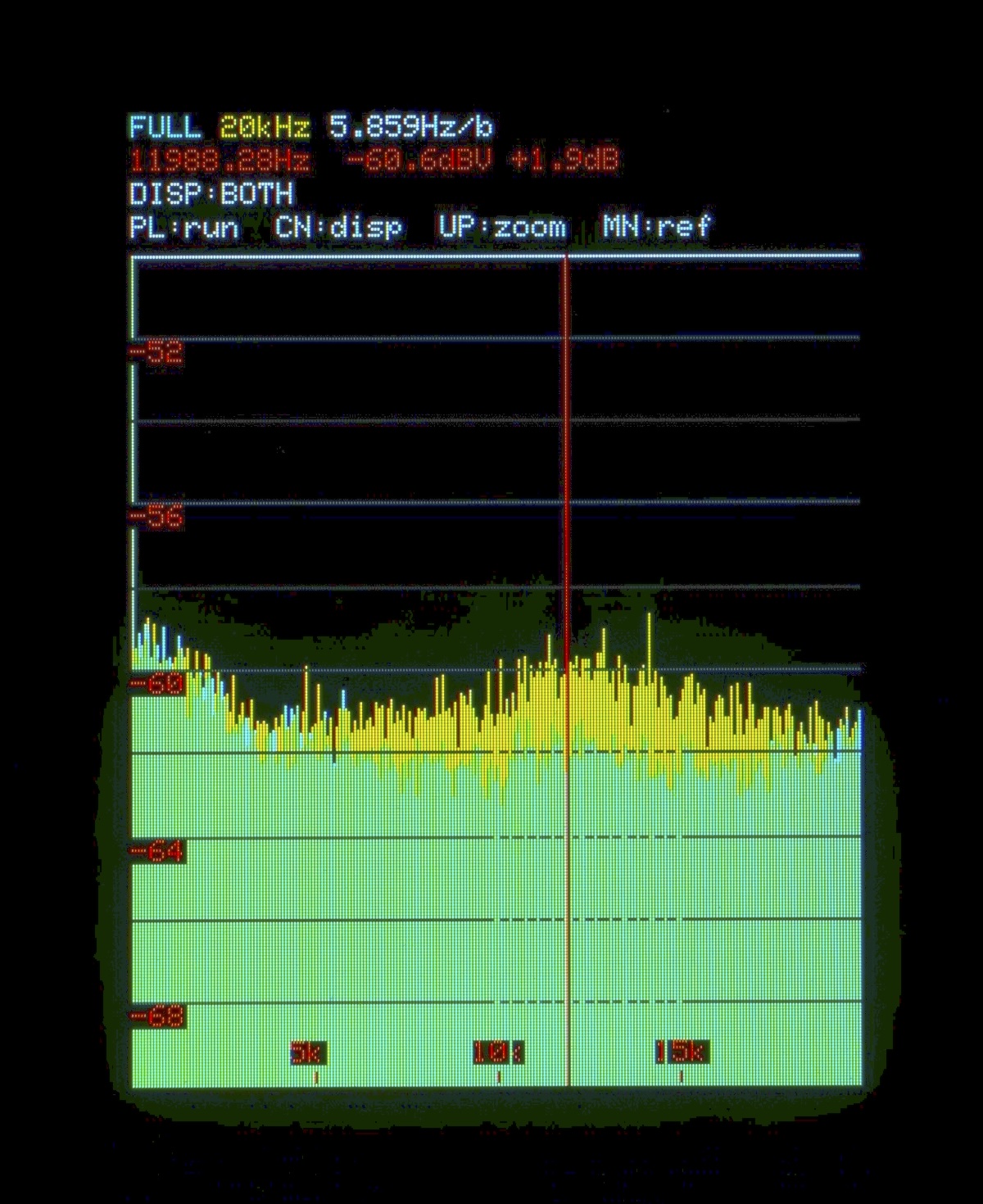
- In the FFT Analyser settings choose input L+R MONO, Full 20 kHz, the 20 dB window and 36 averages.
- Play the white noise on side B, track 4, and average it.
- Store the result as the reference.
- Change the loading and measure again. Both traces appear, and the coloured band between them is the difference.
Here an Audio-Technica AT95E: the reference is the 100 pF of the cable alone. Adding 220 pF, 320 pF in total, gives a broad rise of about 2 dB around 12 kHz. Enough to change the sound, and now you know why.
More to explore
And the rest of the instrument
Azimuth. Set it by crosstalk and by the distortion balance of the two channels, shown side by side, on the single-channel tracks of side B.
Intermodulation. Play two tones together, up to 13 and 14 kHz, and see how much of the difference tone your stylus adds.
Frequency response. Step through 100 Hz to 20 kHz relative to 1 kHz, channel by channel.
Speed. The frequency read-out tells you your platter speed: 1003 Hz on the 1 kHz tone means 0.3 % fast.
Next
Measure your own system
Every StylusScope comes with the Test Record these examples use.