
The evidence
1000 hours with one stylus
Since its first minute of play I have measured one Audio-Technica VM95C conical stylus, on one cartridge and one turntable, playing 24 hours a day and cleaned every twelve. This is what changed, and what did not.
One stylus is a case study, not proof. This is the reason why we plan to collect the data from our users. Read more...
Distortion moves, level barely does
Distortion moved 8–10 dB. Level moved 2.
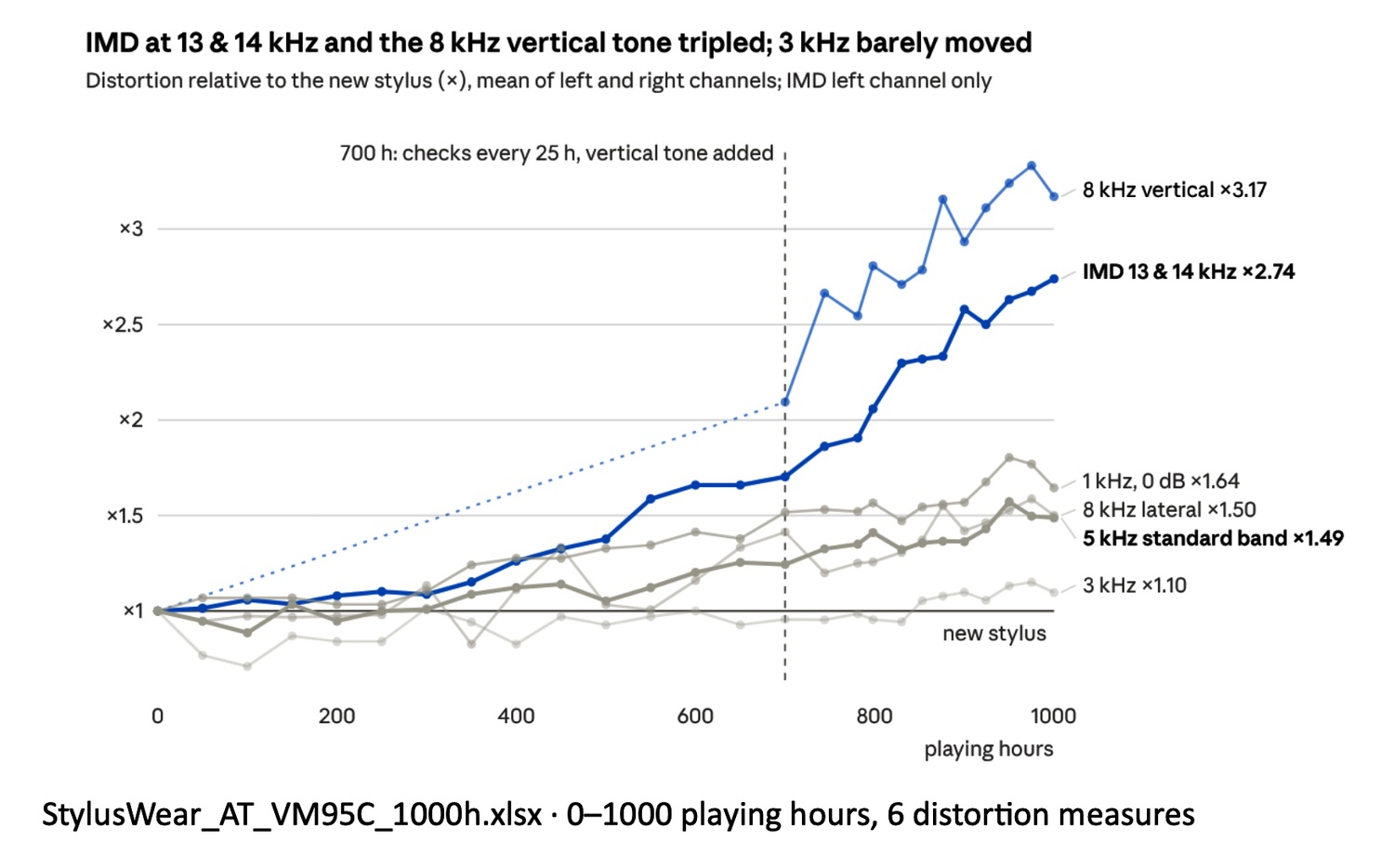
Over 1000 playing hours, one conical Audio-Technica VM95C stylus raised its distortion on
every test signal with a short groove wavelength, while its output level hardly moved. Intermodulation at 13 & 14 kHz grew 2.7-fold and 8 kHz vertical distortion 3.0 to 3.3-fold; the
level at 1 kHz fell by only 0.2 dB.
- The standard wear band (5 kHz, - 12 dB) rose from 5.7 % to 8.5% in both channels
(x1.5), after a run-in dip of 7 to 16 % in the first 100 hours. - Wear accelerated after about 700 hours. The 13 & 14 kHz IMD rose 1.8 percentage points per 100 hours before that point and 5.1 after it (p < 0.001); the 5 kHz band roughly doubled its rate.
- The best indicators were the IMD at 13 & 14 kHz and the 8 kHz vertical tone: largest change, smallest relative scatter. The 1 kHz tone at 0 dB was a surprisingly clean third.
- The 3 kHz tone barely moved (x1.03 and x1.16), and the 8 kHz lateral tone was the noisiest. A study built on one of these alone would underestimate wear.
- Output level is not a wear indicator at these hours: the changes are smaller than the scatter, except on the 8 kHz vertical track (-2 to -3 dB).
Sign up to receive the analysis PDF
You’ll also get our occasional newsletter. Unsubscribe any time.
What did not change
Why one measurement is not enough
The 3 kHz tone on the same track has barely moved in 1000 hours: its level and distortion are within a few per cent of the first day. A study that measured only there would conclude that nothing happens. At 8 kHz, on the other hand, the reading depends on cartridge loading as well as on the stylus: changing from 100 pF to 300 pF lowered the distortion of two different cartridges by 10 to 20 %.
StylusScope looks at a stylus from several sides, at several frequencies, laterally and vertically, and keeps the conditions fixed. A conclusion drawn from one kind of measurement can be confidently wrong.
What you hear
Why nobody notices
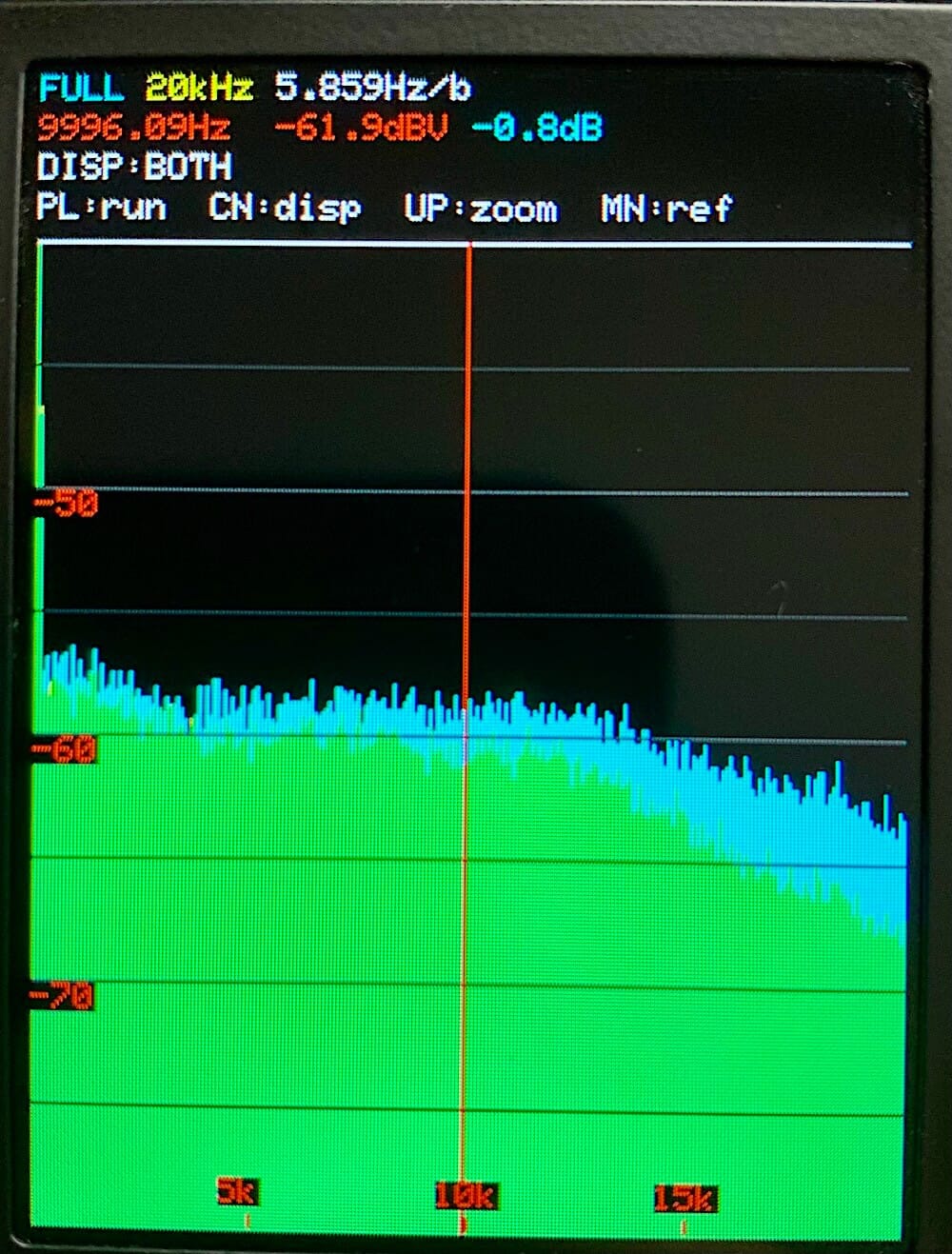
In the white noise spectrum, the new and the 700-hour stylus are indistinguishable below about 10 kHz. Above it, the worn stylus falls away progressively. Almost all musical energy lies below 10 kHz, and the ear adapts to a slow loss of the top octave. Wear does not announce itself; it slowly takes the air away.
LISTENING TEST: I have recorded the same music with the new and the 700-hour stylus, level-matched. Listen to A and B and tell us which is which. Results will be published here.
The run-in
At first, it gets better
A new stylus polishes itself in. Over roughly its first 50 hours, distortion typically falls by 10 to 20 %. An instrument that only ever expected rising numbers would be wrong at the start of every stylus’s life.
The microscope
The time I misread my own stylus
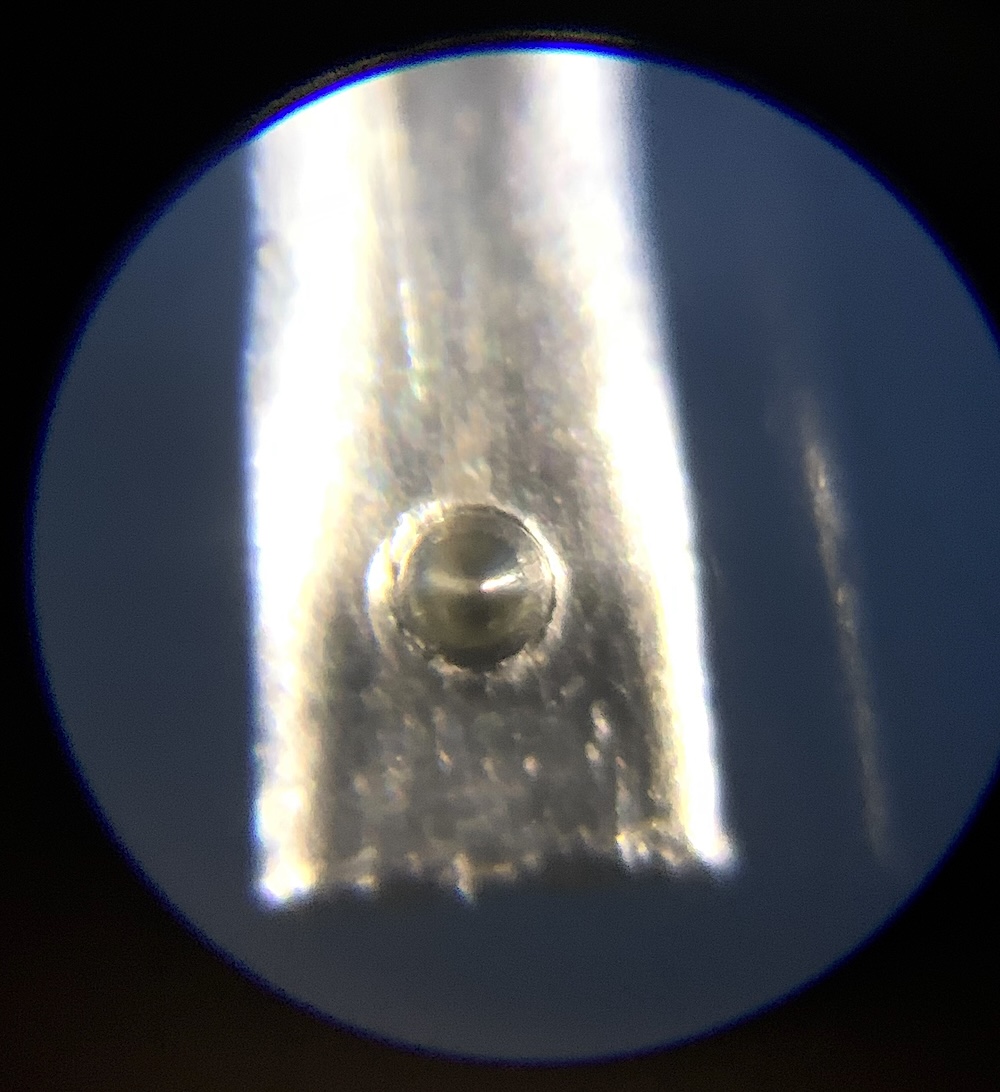
At 700 hours I put the stylus under a 200× microscope, and the classic wear pattern was there: a small, irregular flat right at the tip. But my first reading of the photographs was wrong. I took long bright streaks on the flanks for wear facets. They were reflections.
Thirty years of precision work, and I still saw what I expected to see. That is the real argument for a number. With a microscope, seeing and interpreting cannot be separated. With a measurement, the difference between two numbers is not a matter of opinion.
Context
A worn stylus measures like a new one of a worse shape
A Shure advertisement from the 1970s ranked tip shapes by distortion at 8 kHz: spherical worst, hyperelliptical best, with a spread of about 2.6 times. Our stylus changed by 2.7 to 3.0 times in 700 hours. The figures come from a manufacturer’s own advertising and a different test condition, so read the ranking, not the numbers. But the picture is clear: wear can cost a stylus the advantage its shape was bought for.
Next
One stylus is not enough
Help us build the first open data on stylus wear, or measure your own.